Istiqlal Mosque and Jakarta Cathedral are often compressed into one photograph about coexistence. Their proximity is meaningful, but each is first an active religious institution with its own worship, history, architecture and community. A responsible visitor reads them separately before interpreting them together. Istiqlal emerged from post-independence plans for a national mosque, while the Cathedral parish occupies a much older Catholic institutional history. The surrounding Lapangan Banteng and Pasar Baru area adds a civic frame.
At a glance
Start here
- Treat both buildings as places of worship before treating them as landmarks.
- Learn each institution's own history and vocabulary.
- Let current services and prayer activity determine visitor access.
- Use the wider civic landscape to understand why their proximity matters.
01
See two institutions, not one image
The mosque and cathedral face one another across a central Jakarta road, but proximity does not merge their identities. Istiqlal's official history presents a national mosque conceived after Indonesian independence. Jakarta Cathedral's official site describes a parish and cathedral centered on Catholic worship. Each maintains its own calendar, leadership, sacred space and visitor responsibilities.
Begin with the institution you are entering. Learn its name, current function and expected behavior, then cross to the other only when public access is appropriate. A photograph containing both buildings can suggest a civic relationship; it cannot explain either faith. Avoid using worshippers as visual proof for a slogan. The stronger story comes from institutional histories and the everyday discipline of respecting both communities.
- Use each institution's full name and official channel.
- Keep worshippers out of staged comparison photographs.
- Do not assume simultaneous tourist access.
02
Place Istiqlal in the independence story
Istiqlal means independence, and the mosque's official account connects its founding idea to the years after 1945. Religious and national figures organized a foundation, a public design competition selected Friedrich Silaban's proposal, construction began in the early 1960s, and the mosque was inaugurated for use in 1978. Those milestones make the building part of Indonesia's post-independence civic architecture.
Architecture should be read through that institutional account rather than through guesses about symbolism. Notice scale, structure, circulation and the relation to the former Wilhelmina Park site, then check labels or an official tour for explanations. The building remains a mosque, not an architecture museum. During prayer or major gatherings, visitor movement may be limited; accept the institution's current direction without trying another entrance.
- Connect the name Istiqlal to the official independence narrative.
- Attribute design facts to the mosque's own history.
- Let prayer activity outrank sightseeing plans.
03
Read the Cathedral as a parish and building
Jakarta Cathedral is not maintained primarily as a heritage attraction. Its official site leads with parish life, Mass information, sacraments and community responsibilities, then offers a route into the building's history. That order matters. Visitors should recognize an active Catholic community before examining towers, arches, stained glass or the Cathedral Museum.
The current building is associated with Jakarta's long Catholic history, but dates and architectural labels should come from the parish or official cultural records rather than a casual caption. During Mass, private prayer or pastoral activity, silence and distance take priority. Check current parish information for service times and any visitor condition, and do not interpret an open gate as permission to wander through every part of the complex.
- Read current parish notices before the architecture pages.
- Pause tourism during services and private prayer.
- Ask which parts of the church or museum are open to visitors.
04
Follow Silaban into the civic landscape
Friedrich Silaban provides one architectural thread through this part of central Jakarta. Istiqlal's official history names his competition design, while Jakarta's park record links him to the planning context of Lapangan Banteng. This does not make the mosque, cathedral and park one designed ensemble, but it encourages visitors to look at axes, open space, monumentality and movement across the district.
Walk the public edges slowly enough to notice how each building addresses streets and open space. Use crossings and signed entrances rather than constructing a perfect visual axis from traffic lanes. Lapangan Banteng's principal monument and public facilities add another layer of national history nearby. Any fountain or event should be treated as date-specific and confirmed with the park authority.
- Look for relationships among buildings, roads and open space.
- Stay on public paths and crossings.
- Verify current park programs separately.
05
Make etiquette specific to each place
Modest clothing, low voices and consent-led photography are useful foundations, but the institution's current instructions are decisive. At Istiqlal, use the visitor registration or contact route provided by mosque management when required. At the Cathedral, consult the parish's service and visitor information. Shoes, seating, circulation and photography may be handled differently, so do not transfer one building's procedure to the other.
If staff or volunteers give a direction, follow it without debate. Do not enter a prayer area to reproduce a social-media angle, record people receiving religious rites or narrate loudly for video. Children should understand before arrival that these are not ordinary indoor attractions. A respectful visit can be shorter than planned, and sometimes the correct decision is to remain outside during worship.
- Check the mosque and parish separately on the visit date.
- Follow local instructions for shoes, dress and photography.
- Do not record worship or private religious moments without clear permission.
06
Use museums to understand institutional memory
The Cathedral Museum preserves objects and records connected to the church's history, while Istiqlal's official history page assembles documents and milestones from the mosque's founding. These are different forms of institutional memory. One uses a collection within a religious complex; the other uses an official historical narrative. Both help a visitor move beyond facade comparison.
Museum availability should be confirmed with the Cathedral rather than assumed from an old directory. When access is possible, read liturgical objects within their religious function and do not reduce them to decorative craft. At Istiqlal, distinguish the mosque's own theological or institutional interpretation from an external tourism summary. Comparing how communities preserve memory is useful only when each is allowed to speak in its own terms.
- Confirm Cathedral Museum access directly.
- Keep sacred objects connected to their stated functions.
- Attribute institutional narratives to their publishers.
07
Interpret the neighborhood with care
The neighboring buildings can support a story about civic coexistence, but that interpretation should remain grounded. Their official histories, present communities and shared urban setting provide evidence; a visitor's brief encounter does not prove that all religious relationships in Jakarta are simple or conflict-free. Avoid turning proximity into a claim that erases difference or contemporary complexity.
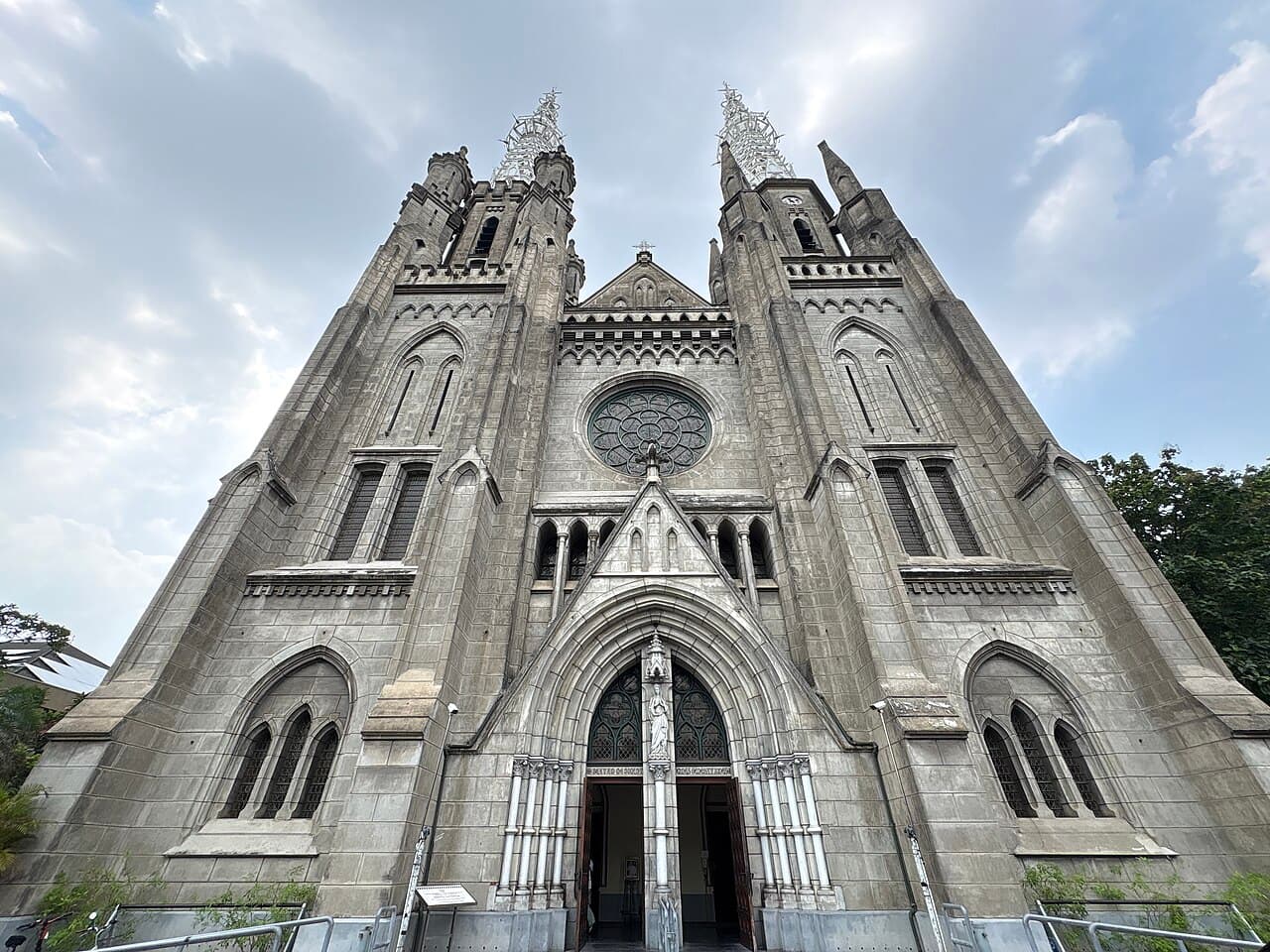
A better conclusion is practical. Two communities maintain important institutions across from one another, and visitors can honor that relationship by learning each history, following each set of rules and giving worship priority. The article photograph shows Jakarta Cathedral itself, so it should not be captioned as Istiqlal or as a complete view of both institutions. Continue into Lapangan Banteng or Pasar Baru only through current public routes.
- Use proximity as a starting fact, not a universal conclusion.
- Keep differences visible alongside shared civic space.
- Caption the Cathedral photograph truthfully.
Useful answers
Reader questions
Can visitors see Istiqlal Mosque and Jakarta Cathedral together?
Their proximity makes a combined district visit possible, but each institution controls its own access. Check prayer and Mass activity separately and accept that sightseeing may pause or end at either place.
Sources: Masjid Istiqlal Jakarta; Jakarta Cathedral Parish; Archdiocese of JakartaWho designed Istiqlal Mosque?
The mosque's official history identifies Friedrich Silaban as the winner of the design competition. Use the institution's account for further architectural interpretation rather than relying on unsourced symbolism.
Sources: Masjid Istiqlal JakartaIs Jakarta Cathedral mainly a tourist site?
No. It is an active cathedral parish. Worship, sacraments and community life come first, so visitors should use current parish information and pause tourism during services.
Sources: Jakarta Cathedral Parish; Archdiocese of JakartaIs the Cathedral Museum always open?
Do not assume so. Jakarta's official landmark page establishes the museum's existence, but access is mutable and should be confirmed directly with the Cathedral for the intended date.
Sources: Jakarta Provincial Government; Jakarta Cathedral ParishRead the evidence
Sources and further reading
These sources support the relevant sections above. Plans and comparisons are editorial suggestions. Check operators for current arrangements.
- Sejarah Berdirinya ↗Masjid Istiqlal Jakarta · Accessed 14 September 2026
The post-independence founding, name, design competition, construction and inauguration history.
- Sejarah Pembangunan Masjid Istiqlal ↗Masjid Istiqlal Jakarta · Accessed 14 September 2026
Detailed official account of the proposal, location debate and design process.
- Katedral Jakarta ↗Jakarta Cathedral Parish · Accessed 14 September 2026
The Cathedral's active parish role, current worship information and official building-history route.
- Paroki Katedral - St. Maria Diangkat ke Surga ↗Archdiocese of Jakarta · Accessed 14 September 2026
Official parish identity, address and the need to check current worship arrangements.
- Landmark Jakarta ↗Jakarta Provincial Government · Accessed 14 September 2026
Official city context for Istiqlal, the Cathedral Museum and nearby central landmarks.
- Taman Lapangan Banteng ↗Central Jakarta City Administration · Accessed 14 September 2026
The nearby civic park, monument, public facilities and date-sensitive program context.