Betawi culture is not a decorative layer added to Jakarta for festivals. It is a living set of arts, foods, clothing, architecture and community practices shaped in the city and its surrounding region. Visitors can begin at Setu Babakan and Museum Betawi, then use the Jakarta Cultural Service's eight official icons as a vocabulary for looking. Taman Mini's Jakarta pavilion provides a second, curated context. This feature explains how to learn without treating one performance, costume or dish as the whole culture.
At a glance
Start here
- Begin at a place responsible for interpretation, especially Setu Babakan or Museum Betawi.
- Use the eight official icons as prompts, not a complete definition.
- Distinguish a living community from a staged cultural presentation.
- Check current programs directly and ask before photographing people.
01
Start with a living cultural place
Jakarta's official cultural-centers page describes Setu Babakan in Jagakarsa as a place dedicated to preserving and advancing Betawi arts and culture. It brings together houses, performances, ceremonies, food and a lakeside setting. The important word is together: Betawi culture is encountered through relationships among people, spaces, objects and practices, not through a single monument that can stand for everyone.
That living context requires visitor restraint. A performance may be public while a family, vendor or worshipper nearby has not agreed to become part of a recording. Observe signs, stay outside working areas and ask before making close portraits. Confirm the current program with the managing unit rather than arriving for an event listed in an old calendar. Regular cultural activity does not guarantee a particular performance on every date.
- Treat Setu Babakan as a community and cultural landscape.
- Verify programs with the current managing channel.
- Ask before photographing identifiable people or work.
02
Use Museum Betawi as an interpretive key
Museum Betawi sits within the cultural village and gives visitors a structured introduction. Indonesia's official museum register identifies galleries concerned with Betawi wedding culture, the eight cultural icons, the Betawi house and temporary exhibitions. That organization is useful because it connects visible objects to domestic life, ceremony and public identity instead of presenting them as isolated souvenirs.
Read the gallery sequence before shopping or tasting. A patterned cloth, architectural ornament or ceremonial object has a context that can be lost when it is reduced to a colorful design. Temporary galleries may change, so treat the museum register as a profile and check current operations separately. If a label uses an unfamiliar Indonesian or Betawi term, record the term accurately and ask staff rather than inventing an English equivalent.
- Begin with the museum's named galleries.
- Record local terms before translating them.
- Use current visitor information for access.
03
Learn the eight icons as a vocabulary
The Jakarta Cultural Service presents eight Betawi cultural icons: ondel-ondel, kembang kelapa, gigi balang ornament, baju sadariah, kebaya kerancang, Betawi batik, kerak telor and bir pletok. Together they span performance figures, decoration, clothing, textiles, food and drink. They offer a practical vocabulary for noticing Betawi references across museums, festivals and public buildings.
An icon list is an entry point, not a boundary around the culture. The official ondel-ondel page, for example, explains materials, paired figures, clothing, head decoration and formal uses. That is far richer than calling it a giant puppet. Apply the same discipline to other icons: identify what the official interpreter says, note the setting in which it appears and avoid declaring every modern variation authentic or inauthentic from appearance alone.
- Name the icon before interpreting it.
- Look for material, use and setting together.
- Avoid treating an official list as the culture's full limit.
04
Read clothing with context
Clothing carries information about occasion, gendered convention, craft and changing public representation. The Cultural Service describes kebaya kerancang through its embroidered openwork, shape, accompanying batik and accessories, then explains ceremonial and institutional uses. This kind of source helps a visitor move from attractive surface to the choices that make the garment legible within Betawi culture.
Do not assume that someone wearing Betawi clothing is a performer available for photographs. Ask permission and avoid directing a person to rearrange clothing or accessories. In museum displays, read the full ensemble rather than isolating one decorative element. In a contemporary event, allow for adaptation. The honest description is what you can verify about that garment and occasion, not a sweeping claim that everyone dresses the same way.
- Observe the complete ensemble and its stated occasion.
- Ask before portraits or detailed clothing photographs.
- Distinguish museum interpretation from everyday practice.
05
Approach food as knowledge, not a checklist
Kerak telor and bir pletok appear among Jakarta's official Betawi icons, but an icon label does not mean every seller prepares the item identically or that it is available every day. Ask a vendor what ingredients are used, how the portion is served and whether it meets dietary needs. Do not invent a definitive origin story when the official page does not support one.
Food is also labor. Let vendors set the pace, ask before filming preparation and pay the stated price without turning every exchange into a performance. If you have allergies or religious dietary requirements, ask directly and make your own decision; a dish name alone cannot guarantee ingredients or cross-contact. The useful cultural question is how people describe and serve the food in this place, not whether it completes a tourist list.
- Ask about ingredients and preparation directly.
- Do not assume daily availability from icon status.
- Treat vendors as businesses, not exhibits.
06
Compare Setu Babakan with the Jakarta pavilion
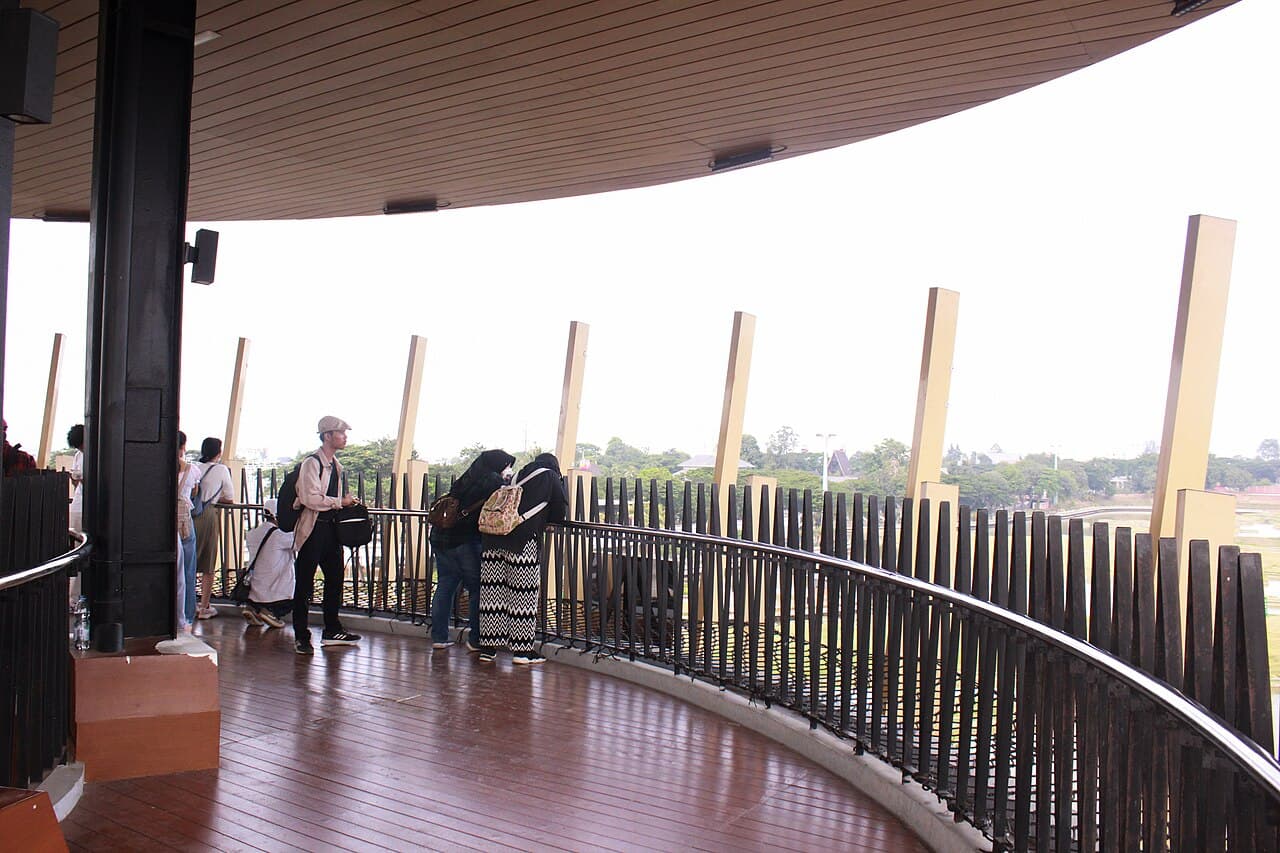
The Jakarta government describes the DKI Jakarta pavilion at Taman Mini as a curated place for Betawi houses, performance, library and exhibition material. It can extend a Setu Babakan visit by showing how the city presents its culture inside a national park of regional pavilions. The two settings have different jobs: one is a designated cultural-village landscape, while the other represents Jakarta within a collection of provinces.
That difference is worth noticing. Ask what each setting foregrounds, who manages the interpretation and how architecture is used. The accompanying article photograph shows Taman Mini, not Setu Babakan or Museum Betawi; it is included as Jakarta-pavilion context only. Use the venue's current program pages before planning a performance, because official descriptions of regular activity do not establish a schedule for your date.
- Compare the purpose of each curated setting.
- Do not label the Taman Mini image as Setu Babakan.
- Verify date-specific programs with the venue.
07
Continue beyond a single visit
A respectful first encounter should produce better questions. Use the Cultural Service's pages to identify the correct names of icons, then look for museum programs, publications and performances led by people with direct knowledge. Avoid claiming expertise after one afternoon. Betawi culture has internal variety, historical change and contemporary creativity that a short destination feature can only introduce.
When sharing what you learned, attribute the institution and keep observation separate from generalization. Say where you saw an object, who explained it and whether the event was staged, ceremonial or everyday. Do not copy sacred, family or community material into content simply because it was visible. The most useful outcome is a more precise way of seeing Jakarta and a willingness to let Betawi institutions and practitioners define their own work.
- Attribute definitions to the responsible cultural institution.
- Separate one observation from a claim about all Betawi people.
- Follow practitioner-led programs for deeper learning.
Useful answers
Reader questions
Where should a visitor begin learning about Betawi culture?
Begin at Setu Babakan and Museum Betawi, where the cultural landscape and structured galleries connect houses, arts, ceremony, clothing and daily life. Check current programs before travelling.
Sources: Jakarta Provincial Government; Ministry of Culture of the Republic of IndonesiaWhat are Jakarta's eight official Betawi cultural icons?
The Cultural Service lists ondel-ondel, kembang kelapa, gigi balang, baju sadariah, kebaya kerancang, Betawi batik, kerak telor and bir pletok. Use them as a starting vocabulary, not a complete definition.
Sources: Jakarta Cultural ServiceIs the Jakarta pavilion at Taman Mini the same as Setu Babakan?
No. The pavilion is Jakarta's curated presentation inside Taman Mini's national collection of regional pavilions; Setu Babakan is a designated Betawi cultural-village landscape in Jagakarsa.
Sources: Jakarta Provincial Government; Taman Mini Indonesia IndahCan visitors photograph Betawi performances and vendors?
Follow venue rules and ask identifiable people before close photography or filming. A public cultural setting does not remove an individual's ability to refuse, and vendors should not be treated as exhibits.
Sources: Jakarta Provincial Government Legal Documentation Network; Jakarta Provincial GovernmentRead the evidence
Sources and further reading
These sources support the relevant sections above. Plans and comparisons are editorial suggestions. Check operators for current arrangements.
- Pusat Kebudayaan ↗Jakarta Provincial Government · Accessed 14 September 2026
Setu Babakan's cultural purpose and the role of the DKI Jakarta pavilion at Taman Mini.
- Museum Betawi ↗Ministry of Culture of the Republic of Indonesia · Accessed 14 September 2026
Official museum registration, management and the themes of its three gallery levels.
- Dinas Kebudayaan DKI Jakarta ↗Jakarta Cultural Service · Accessed 14 September 2026
The official list of eight Betawi cultural icons and institutional interpretation route.
- Ondel-Ondel ↗Jakarta Cultural Service · Accessed 14 September 2026
Ondel-ondel materials, design, meaning and official uses.
- Kebaya Kerancang ↗Jakarta Cultural Service · Accessed 14 September 2026
Garment form, materials, accompanying elements and official use contexts.
- Unit Pengelola Kawasan Perkampungan Budaya Betawi ↗Jakarta Provincial Government Legal Documentation Network · Accessed 14 September 2026
The management unit's official responsibilities for preservation, museum operations, public programs and visitor areas.
- Regional Pavilions ↗Taman Mini Indonesia Indah · Accessed 14 September 2026
The regional-pavilion model and Jakarta's place within that curated national setting.